

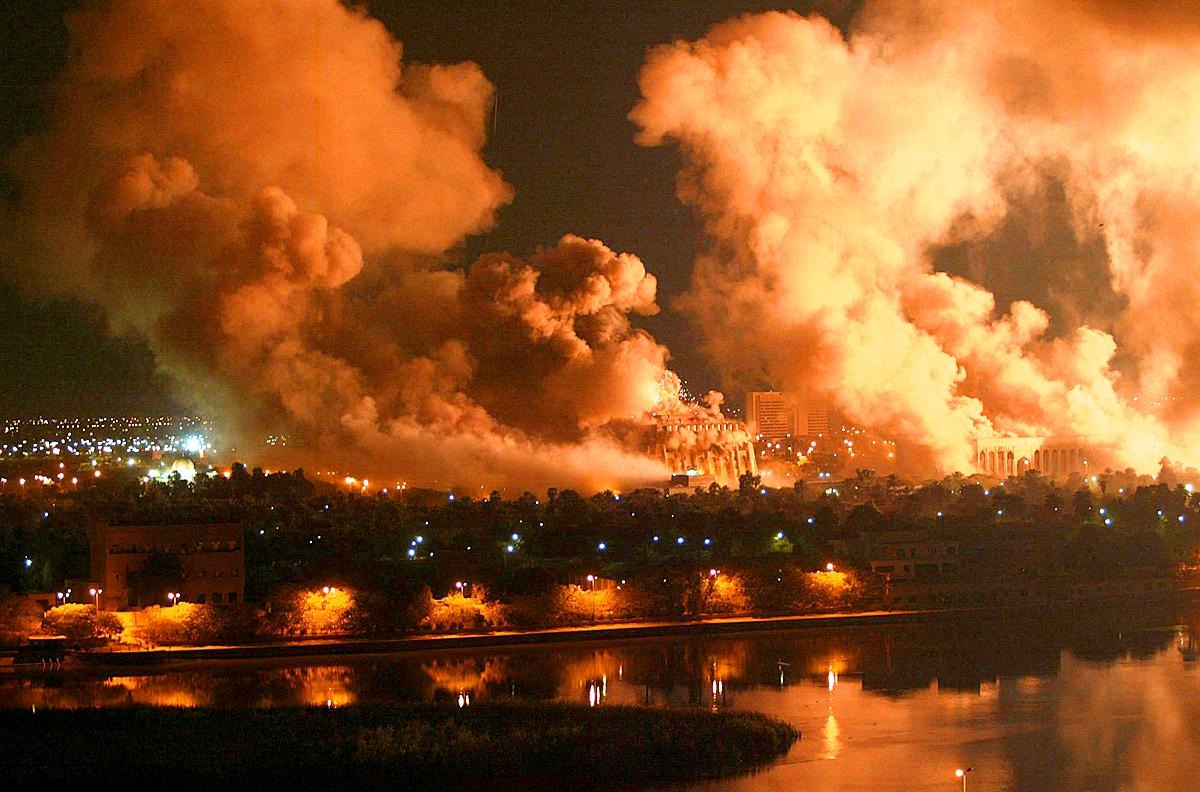
After the start of a new phase of war by the United States and Israel against Iran, justified as a “humanitarian intervention” to “liberate the people of Iran” from the Islamic Republic, hundreds of civilians have already been killed in the third week of the war. These include elementary school girls in the city of Minab. Senior officials of the Islamic Republic and top military personnel have also been targeted. Extensive damage to urban infrastructure has occurred across the country.
The interventionist opposition and some of its supporters have attempted to justify the deaths of ordinary people and the destruction of infrastructure. One of their main arguments, after attacks on oil depots and energy infrastructure, is that the primary goal is the destruction of the Islamic Republic. Therefore, the destruction of infrastructure is considered a “side cost” of this goal. Similarly, the deaths of ordinary people are treated as a side effect. The following text responds to this type of argument that justifies imperialist attacks. It does so through a brief look at the experience of Iraq’s “reconstruction” after the U.S. occupation in 2003.
For Iranians who these days repeatedly hear the phrase, “The destruction of Iran’s infrastructure doesn’t matter; we’ll build a better one later,” the experience of Iraq can stand before their eyes as a full-scale historical experiment, an experiment that makes it possible to observe the real logic of war in the era of late imperialism at the level of its economic, institutional, and political mechanisms.
The reconstruction of Iraq after the 2003 invasion, initiated by the decision of the administration of George W. Bush, became one of the most expensive and, at the same time, one of the most controversial reconstruction projects in contemporary history. However, understanding it is not possible merely by reviewing expenditures or individual projects; for a deeper comprehension, two key concepts must be taken into account: “private war” and “the logic of destruction for reconstruction.”
The concept of “private war,” used in many political economy analyses of the occupation of Iraq, refers to a situation in which the role of private companies in war and occupation reaches an unprecedented level. Tasks that were previously monopolized by states and armies are outsourced to contractors.
In the Iraq War, this process occurred on a rare scale. The security company Blackwater played a role in protective and security operations. The oil company Halliburton received massive logistics and energy contracts. Engineering and construction giants such as Bechtel and Parsons Corporation became active in infrastructure reconstruction projects.
In such a model, war is launched by states under the claims of democracy, human rights, and other false justifications. But the profits generated by war are quickly tied to a network of private contractors. From the outset, the war is defined and designed around the interests of these contractors, and more deeply, around the continuation of the cycle of profit and capital accumulation.
Under this logic, war, the destruction of infrastructure, and the highest form of domination—occupation—are carried out with the cooperation and complicity of private companies. Reconstruction is often entrusted to the same companies or to economic networks close to them.
A concrete and large-scale example of this mechanism can be seen in Iraq. In that country, the central instrument of the reconstruction economy was a specific type of contract known as “cost-plus.” Under these contracts, companies received not only the project’s costs, but also an added fixed percentage of profit.
In such a structure, the longer and more expensive the project becomes, the greater the company’s profit. This model effectively reverses the economic logic of reconstruction. Instead of projects being completed efficiently and quickly, as one would expect from “reconstruction,” delays, rising costs, and even inefficiency translate into higher profits for companies.
For this reason, many opponents of the occupation of Iraq have argued that post-war reconstruction was not merely part of the economic logic of private war. It also functioned as a means of resource extraction, the imposition of economic instability, and the pursuit of the political and economic objectives of the occupying state.
To fully understand this logic, one must also consider the issue of infrastructure destruction. A question that has been raised repeatedly is this: why were certain infrastructure facilities targeted during the Iraq War, even though Saddam’s government could have been overthrown without their complete destruction? Why was Iraq’s electricity grid, seriously damaged during the Gulf War and only partially repaired by 2003, targeted again?
The answer lies within a framework that can be called the “logic of post-war reconstruction.” If infrastructure is not destroyed, a reconstruction market does not emerge. Giant engineering and contracting firms need massive and costly projects to sustain their operations and profits. War can create such a market.
The experience of Iraq provides many examples of this situation.
In the electricity sector, after the fall of the government of Saddam Hussein, it was expected that the country’s energy grid would quickly improve. In reality, in many regions, conditions became worse than before the war.
One reason was the installation of equipment that quickly failed without spare parts and exclusive service contracts from the same Western companies. As a result, infrastructure that was supposedly built for modernization created long-term technical dependence on those same foreign firms.
Another example can be seen in the Nasiriyah water treatment plant project. It was considered the largest water reconstruction project in Iraq. Yet for years it operated at only about twenty percent of its capacity. This was not because of water shortages. It was due to the mismatch between the selected technology and local conditions and technical capacity. This represents a form of “dependency engineering,” in which large-scale destruction guarantees profitable contracts.
Perhaps the example of Bechtel can help explain the logic behind these companies’ entry into reconstruction projects.
In 2000, the government of Bolivia was pressured by the World Bank to privatize water services in the state of Cochabamba. The tool of this pressure, as in similar cases, was to condition loan payments on privatization.
The exclusive winner of this privatization was a company in which Bechtel was the majority owner. As a result of the contract with the Bolivian government, this company obtained a 40-year concession worth $2.5 billion to provide water and sewage services to the residents of Cochabamba, as well as electricity generation and agricultural irrigation.
The result was that water prices almost immediately rose by 35 percent. By the second month, the increase reached 60 percent, and in some cases even more. Indigenous residents, whose total monthly income was about $100, were forced to pay at least $20 per month for water. The company even took control over rainwater.
Eventually, the issue turned into a popular uprising that forced the government to retreat and cancel the water privatization. Bechtel left Bolivia and later filed a claim for $25 million in compensation.
The same company, in 2003, entered the reconstruction of occupied Iraq through a $680 million contract with the United States Agency for International Development. In this way, war and occupation in Iraq directly became a tool to compensate a corporation that had been expelled from another part of the world.
The management of Iraq’s oil revenues was equally controversial. After the occupation, and under UN Security Council Resolution 1483, Iraq’s oil revenues were centralized in an account held at the Federal Reserve Bank of New York.
The official purpose of this mechanism was to protect Iraq’s assets from claims by creditors from the era of Saddam Hussein. Legally, ownership of these revenues remained with the Iraqi state. But in practice, access to these resources passed through financial mechanisms linked to the U.S. government. Critics described this structure as a form of “financial trusteeship.” They argued that, in practice, Baghdad had to operate within a financial system under Washington’s influence in order to use its own foreign currency reserves.
Alongside the mechanism of oil revenue extraction, the management of cash resources also became controversial. In the first years after the occupation, about $12 billion in cash was flown into Iraq to cover the immediate expenses of the interim government and reconstruction projects. Reports by the Special Inspector General for Iraq Reconstruction showed that oversight of these funds was highly ineffective. A large portion of the money was never fully audited. In this way, one of the largest organized plunders of recent decades took place within the reconstruction of occupied Iraq.
One of the most symbolic examples of inefficiency in reconstruction projects was the Baghdad Police Academy project. It was carried out by DynCorp. The project cost about $75 million.
Official reports criticized it for serious technical defects. The ceilings leaked. The sewage system did not function properly. There were even reports of sewage leaking from the ceilings. Many of the training facilities were incomplete or unusable. In the end, parts of the project were completely abandoned, while the contractor had already received the cost and profit of the contract.
At the same time, the Coalition Provisional Authority, led by Paul Bremer, issued a series of economic orders that broadly “liberalized” Iraq’s economy. These orders allowed foreign companies to have full ownership in many sectors. They sharply reduced trade tariffs. They opened Iraq’s banking system to foreign investment.
However, the oil sector was excluded from direct privatization. Its strategic importance was so high that even within this economic framework, full transfer to private companies was not proposed. Instead, long-term service contracts were signed. These contracts allowed foreign firms to participate in the management and exploitation of oil fields without formal ownership.
Let us step back from these experiences and return to the initial question. Does the destruction of a country’s infrastructure in war necessarily lead to better reconstruction? The experience of Iraq says no.
In the decades after the war, Iraq’s electricity grid has continued to face production shortages and widespread blackouts. Access to clean water remains limited in many areas. Some of the costly reconstruction projects were left unfinished. Others operate at very low capacity.
In contrast, many foreign contracting companies earned enormous profits from war and reconstruction contracts.
From this perspective, the logic of private war is not necessarily to destroy infrastructure in order to later build a “better version.” In many cases, this logic turns destruction, crisis, and expensive reconstruction into an economic cycle. This cycle is highly profitable for the actors of war.
The experience of Iraq should remind us that in contemporary wars, bombing infrastructure is not only a military act to bring governments to their knees. It is also the beginning of a period in which reconstruction does not mean “building better.” It means plunder and deep economic and political misery for the people.
The reconstruction of Iraq bore no resemblance to the Marshall Plan. Some shameless defenders of military aggression against Iran, who not only justify but encourage the destruction of infrastructure, expect a similar outcome for a “liberated” Iran. Yet the Marshall Plan was not merely a reconstruction project in countries devastated by the Second World War. It was also a tool to consolidate the Western bloc against the Soviet Union and to strengthen the economies of Western-aligned countries in postwar Europe.
In contrast, the experience of Iraq shows that under today’s historical conditions where wars have become the largest projects of “neoliberalizing” the economy of a war-torn country, the idea of repeating a Marshall Plan in our region is less grounded in the political economy of contemporary wars. It is more a naive fantasy, a political deception, and a way of erasing resistance to the large-scale destruction of a country’s infrastructure.
It should be noted that the objectives of the United States and Israel in a military attack on Iran could take various forms. Not all of these objectives are necessarily clear to us.
These goals could range from forcing the Islamic Republic to surrender and accept political conditions, to a regime-change scenario, and in some estimates, even to a ground intervention and territorial occupation similar to what occurred in Iraq after 2003.
It is also possible that the war remains limited to airstrikes and does not expand to a ground invasion. However, “targeted destruction of infrastructure” is a common element in all these scenarios.
In a surrender scenario, attacks on military, economic, and vital infrastructure aim to impose maximum economic and human costs to force the government to retreat.
In a regime-change scenario, whether achieved through military occupation or by shaping a political order favorable to the West, the destruction of infrastructure serves another function. The destruction can, as seen in Iraq, create an opportunity for extensive entry of Western private companies under the label of “reconstruction.” It also produces an economy that is damaged, dependent, and unable to rebuild independently. Iraq’s experience is a well-known example of this pattern.
In a regime-change scenario and the establishment of a U.S. and Israeli–favored political order, the new regime’s viability relies on the very conditions that produced it: war and infrastructure destruction. This has a dual effect. On one hand, it opens the way for foreign companies to enter “reconstruction” projects. On the other hand, the country’s economy is pushed toward a form of “liberalization.”
This liberalization practically means removing society’s control over resources and economic decision-making, weakening or bypassing regulatory institutions, rolling back labor laws and other worker protections, downsizing the state, and expanding the private sector.
In this framework, the “necessity of reconstruction” becomes a legitimizing tool to justify structural transformation. In practice, this transformation is nothing other than advancing a class war against workers and urban poor.
It can be imagined that in a scenario where the Islamic Republic surrenders, the reconstruction of infrastructure would follow a pattern similar to a regime-change scenario.
However, if the Islamic Republic survives and prevails, although foreign companies from hostile countries would likely not participate in reconstruction projects, the regime itself would carry the neoliberal logic of reconstruction to its fullest. This process would ultimately mark the beginning of a new phase of class war against the working class.
In this way, the bombs currently falling on infrastructure, accompanied by collective cheer and justifications from war advocates, are not only destroying “national assets” but also laying the groundwork for intensified exploitation and extraction in the future.
Comment here