

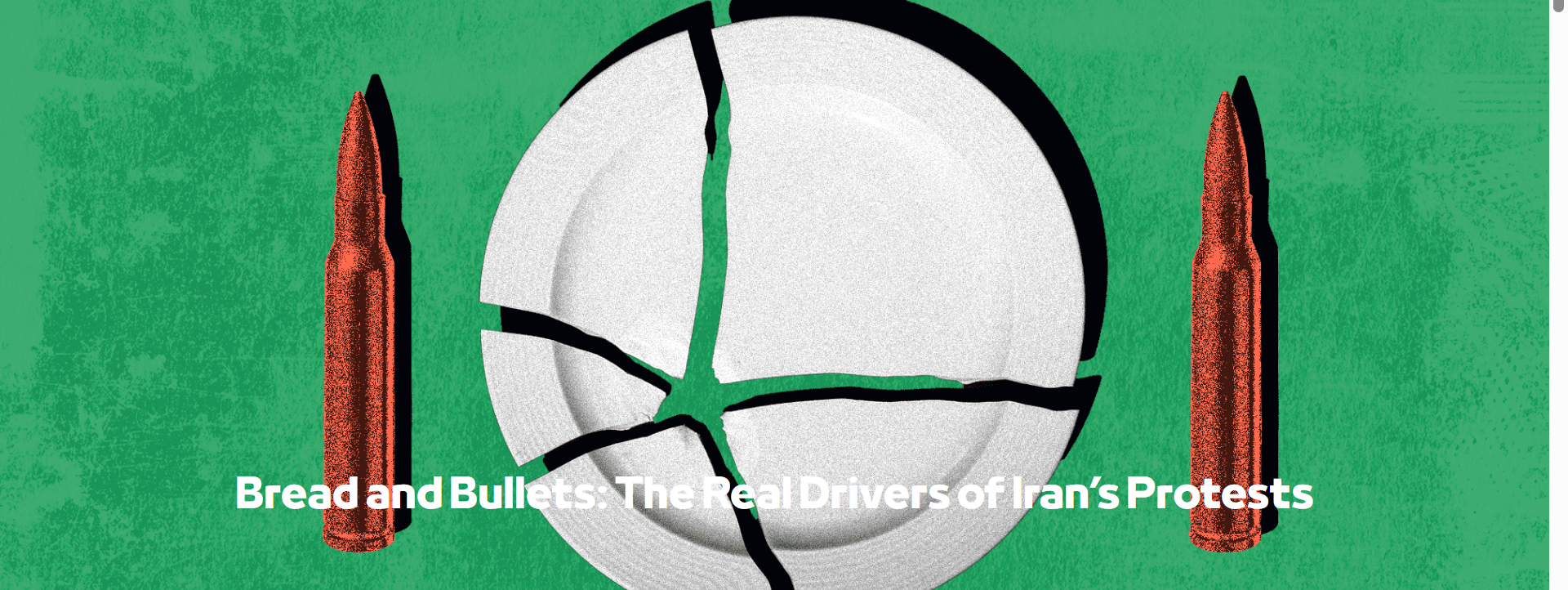
People are driven to protest not by foreign signals but by desperation. When survival collapses, and organisation is criminalised, symbols replace strategy.
In the weeks before the bazaar strike in late January 2026, Iran’s economy was already suffocating under runaway inflation and rapid currency depreciation, price deregulation, and intensified regressive taxation. The soaring cost of basic goods had pushed large segments of the population to the brink, turning everyday shopping into a test of survival. Rice, a core staple of the Iranian diet, became a stark symbol of the collapse. A standard bag of rice rose to nearly ten million rials, roughly equivalent to a worker’s minimum monthly wage. Meat and dairy soon followed, quietly disappearing from ordinary meals. During the protest period that followed the bazaar shutdowns and local street mobilisations in multiple cities, prices continued to rise. Eggs and yoghurt, once the last affordable sources of protein for low-income households, slipped beyond reach, joining rice and meat as unattainable necessities. Indirect taxes and higher distribution costs were passed directly onto consumers, while wages remained frozen in real terms, as nominal pay failed to keep pace with inflation. Faced with a rapidly depreciating currency, many families began buying groceries in instalments or on informal credit. This is the ground from which Iran’s current protests emerge.
We write as members of the Nesvan Committee, a Marxist-feminist collective rooted in working-class struggles with members inside and outside Iran. Over the past three years, we have focused on the struggles of working-class women in Iran under a repressive state and the weight of severe imperialist sanctions. We also address urgent issues such as the reproductive crisis and the role of women in resistance. From this vantage point, we face a political trap. The protests are legitimate because material conditions have deteriorated to the point where silence is no longer possible. Yet the space for independent alternatives has been systematically closed. When parties, unions, and feminist networks are criminalised, diaspora forces with media access and resources become disproportionately visible and begin to claim ownership over the uprising.
On the street, many people are searching for any symbol that feels capable of breaking the deadlock. In that vacuum, the Pahlavi or monarchist current has positioned itself as the main “alternative,” often tying the language of liberation to external sponsorship, from appeals for harsher sanctions to calls for military action or other forms of intervention. Meanwhile, other political forces exist, but repression and fragmentation have left them under-organised and far less influential, limiting their ability to intervene meaningfully inside the protest movement.
This contradiction between justified resistance and its attempted capture by reactionary forces has not remained internal to the movement. It has shaped how the protests are interpreted, narrated, and instrumentalised both inside and outside Iran. Two dominant narratives are now circulating, and both are misleading.
One, promoted by the so-called “axis of resistance,” frames the protests as a foreign plot entirely orchestrated by Israel or the West, using this claim to justify repression and strip the uprising of any social or economic legitimacy.
The other, common among anti-Iran or regime-change circles, treats the protests as evidence of a desired geopolitical realignment, reading popular anger primarily as confirmation that Iran’s regional role must be dismantled, rather than engaging with the protesters’ material demands. One narrative kills and justifies killing by securitising protest. The other endangers protesters by instrumentalising their struggle for regional rivalry, sanctions politics, and intervention fantasies. Although these narratives appear opposed, they converge in practice. Each relocates the Iranian agency outside Iran, and each turns a social uprising over survival into a geopolitical story about power.
The more basic truth is this. The current moment has been produced by the combination of an unliveable economic situation and a state that has responded to social and economic demands with raids, mass arrests, politicised trials, and lethal force rather than relief. People are driven to protest not by foreign signals but by desperation. When survival collapses, and organisation is criminalised, symbols replace strategy. In the absence of credible paths toward relief or resolution, many are compelled to grasp at whatever force, symbol, or promise may be. What can look like “external leadership” from afar often reflects something more grim: a political landscape where independent organisation has been dismantled, and where people are left to choose between silence and catastrophe.
That is why foreign posturing is a material risk multiplier. External sponsorship does not protect protesters; it raises the cost of dissent by feeding the regime’s preferred story about “plots” and “infiltration.” Yet once protests erupt, Israeli and U.S. political discourse, echoed by segments of the diaspora openly calling for intervention, rushes to frame events inside Iran as a theatre of external influence. Public posturing and hints about support, coordination, or covert material backing are often presented as psychological warfare. In practice, they are reckless signals sent from a distance, with little regard for those facing armed forces in the streets. The point is not whether these claims are true or exaggerated, but what they enable.
The Iranian state seizes on such rhetoric immediately. It is folded into a familiar security narrative and deployed to justify lethal force. Protesters demanding wages, food, and dignity are recast as Mossad agents, rather than as citizens making social claims. Hunger becomes treason. Dissent becomes war. Live ammunition follows. Entire neighbourhoods are placed under siege. Killings become harder to document precisely because of the state-imposed communications blackouts in the first weeks of the massacre, to prevent information from leaving the country. Internet shutdowns are not incidental; they were part of how violence is carried out and concealed. Because the blackout blocks verification as well as reporting, the full death toll remains contested, but credible reports and documentation efforts point to mass killing on a scale not seen in Iran’s modern history. In other words, the state’s story about “foreign plots” does not merely misrepresent the protests; It helps authorise the massacres that follow.
However difficult in this moment, we believe the only way out of the current deadlock is sustained grassroots organising rooted in people’s material needs, and collective self-determination. Without such organising, reactionary forces grow in the political vacuum produced by repression and despair and political meaning is increasingly set by whoever controls the loudest megaphones. This helps explain why chauvinist and xenophobic slogans like “No Gaza, no Lebanon” surface at moments of intense crisis. For many, they register as a protest against the Islamic Republic’s regional project and the diversion of resources outward, while life at home becomes unliveable.
The same dynamic shapes what is often seen in diaspora demonstrations. Monarchist imagery, and in some cases, along with Israeli flags, do not reflect a coherent political program inside Iran. They reflect a representational crisis produced by the systematic repression of independent political organisation inside the country, combined with the disproportionate visibility of diaspora forces with media access and external sponsorship. When grassroots organisations are crushed, symbols substitute for strategy, and the struggle is more easily captured, distorted, and marketed as something it is not.
Anti-imperialism worthy of the name must stand with people where they are, in their struggles for life and dignity, not only when those struggles fit a preferred geopolitical alignment or advance someone else’s regional agenda. A politics that claims to oppose Israeli and U.S. imperialism cannot require silence about repression in Iran. Nor can opposition to repression in Iran be outsourced to the same imperial powers that have orchestrated a genocide and devastated the region for decades. Any position that treats Iranian lives as instruments in a broader geopolitical contest ultimately strengthens the forces of repression on the ground.
To move beyond this false binary, we issue a call for connection. We aim to establish sustained, meaningful relationships with organisations and movements across the region that are rooted in social demands and collective self-determination. If the Islamic Republic relies on isolation and fear to govern, and if imperialist interventionist forces rely on proxy narratives to advance their aims, then cross-border solidarity built on shared material struggle is not a slogan or moral gesture, but a political necessity.
Comment here