

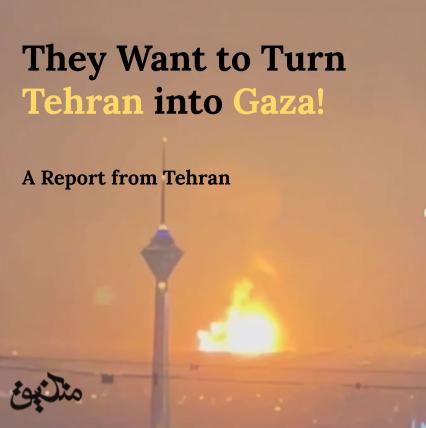
A Report from Tehran
It is the early hours of dawn on the eighth day of the war; the fear of yesterday’s explosions has stolen sleep from everyone’s eyes. The explosions begin. M counts the sounds, distinguishing blasts from anti-aircraft fire. The elevator hums: neighbours head to the rooftop one by one. M, holding P in their arms, sobs quietly. M says, “They’re turning this place into Gaza too.” Dawn breaks. The sounds cease, but a friend calls: “Mehrabad has been pulverized.” The friend swallows the lump in their throat and says goodbye.
Day seven; around five in the morning, the sky is dark, fighter jets fill the air. Within minutes, a symphony of devastating explosions begins. The city trembles. Eyes search the sky for jets and falling bombs from Israel and the United States. Crying echoes through the building. Somewhere nearby, structures are smashed apart. With every sound, we cling to one another. A neighbour leans from a window and shouts, “Allahu Akbar!” Another voice rises from the alley, cursing everyone, Khamenei, Netanyahu, and the man chanting vehemently. For over forty minutes, Tehran endures the most intense attacks. These minutes plant a fear in the hearts of those of us who survived that no therapy could ever heal.
I return to the first day of the war. Sleep still clings to people’s eyes. Shops are just raising their shutters. People stand before cafes, coffee in hand. Daily wage workers gather around the square as they do every March, hoping for work. A child, hand in hand with their mother, walks toward kindergarten when the shriek of missiles and bombs from Israel and the United States jolts the city awake. Yes, the war has begun. A new calamity crashes upon the people.
Within minutes, streets become parking lots of cars with desperate, angry occupants. People walk shoulder to shoulder on sidewalks, one eye on their phones, one on the sky. Mobile networks falter, deepening the panic. Unprecedented crowds gather before metro stations. A young girl cries. A woman smokes anxiously. Teenage boys in school uniforms emerge from the metro; one shouts, “Bro, they hit Ghalibaf’s house!” A middle-aged woman urges others not to enter: “It’s unsafe. If the metro is hit next, we’ll be buried underground.” A man, pleased, declares, “Reza Shah the Second has kept his promise!” Girls sit before the metro; one weeps in fear. Her friend seeks a motorcyclist for a ride. A monarchist man calls out, “Don’t cry, we’re being liberated!” Another girl snaps, “Shut up!” From the street, two drivers argue. The city unravels. The war hasn’t truly begun, yet the people’s patience has snapped.
Morning of day two, around 11:00 a.m. A strange sound echoes through the house as if a storm battered doors and windows. In truth, fighter jets have turned the city into a tempest. Seconds later, the city is smashed apart. The noise is so loud neighbours gather in the parking garage. Anxiety marks every face. M cries. The neighbour’s daughter clings to her mother. Families call relatives across the city. The second wave begins: sound, then explosion, then smoke filling sky and lungs. A neighbour arrives: “The city has become hell.” We pack essentials into one bag and two backpacks, heading out to join family. Main routes to Qasr Crossroads are closed. A gas station line blocks the street. People stand stunned by the roadside in pyjamas. We enter Shariati Street via Bahar Street’s side alleys. Shattered glass from a tall building carpets sidewalk and street. Security forces on foot, on vehicles stand guard, clearing paths. Smoke from explosions fills alleys leading to the military base. A building appears destroyed. The alley midpoint is blocked, ground covered in dust. A young woman stands by the road, wiping her elderly mother’s tears. I am terrified. My body trembles from within. Armed men have cordoned off the street up to Enghelab.
Until dusk, the city is calm. The Ministry of Intelligence, IRGC Intelligence, and The Police Command (FARAJA) send threatening texts. Gradually, streets fill with supporters of the Islamic Republic. We go out to buy supplies. Everywhere, news announcers speak; everyone reports on the war. Then it begins again. Near Baharestan, bombs rain on the street, hundreds of meters from where mourners for Khamenei stand. Smoke and sulfur fill the air. Streets are blocked. I try to move forward; they won’t allow it. The municipal building lies destroyed, burning. A few meters ahead, another building is targeted. I see only smoke trails, unable to recall the location. The neighbour’s son, who roamed the city the next day, recounts: the smoke came from a clinic and a residential building adjacent to the Basij. As I recall that base had been abandoned for years; no one went there.
Time has slipped from my grasp. My calendar runs on war time. I count the days. Day four, Grandmother cooks, murmuring prayers. VPNs fail. We blocked Iran International. Grandmother says, “They celebrated our deaths. Khamenei is just an excuse.” BBC and VOA connect spottily. We move between rooftop and house, seeking news. On the rooftop, it starts again. They bomb the mountains east of Tehran. Within seconds, explosions reach the city. Houses are targeted somewhere near Afssariyeh. The blasts feel closer. We abandon satellite TV and flee the rooftop. We check news on the Baleh app. The Besat Residential Complex was hit. I think of my friend SH, who lives there. Neither they nor their family are military. A retiree of the Martyrs Foundation, SH spent years narrating the suffering of women whose lives the Iran-Iraq war destroyed. I message to check in. The target was two blocks away. M also lives near Afssariyeh. I message them too. They send curses to Khamenei, the Islamic Republic, Israel, and the United States, writing: “They’re destroying Tehran, and these people are asleep.”
Afternoon of day five. Tehran shakes repeatedly. A stadium below Khorasan Square, before Besat Highway, is hit. Simultaneously, news arrives: Azadi Stadium also struck. H went to the South Terminal to deliver a package. S (their spouse) calls anxiously; no answer. These days, every unanswered call conjures the death of a loved one. An hour later, H returns: “Besat Stadium is crumpled. Wherever they struck, they leveled it to the ground.” Ferdowsi, Sepahbod Qarani, Kargar Jonubi consumed by smoke and dust. S calls. Their home is near Enghelab Square. They weren’t home, but neighbours report shrapnel reached their house. I lose contact with SH for hours. After several calls, a message arrives: Hakimiyeh was hit. A warehouse and one company building damaged; the building housing corporate advertising teams, adjacent to a semi-prepared food production facility.
Morning of day six. My mother’s colleague calls: the Marzdaran area was struck, beside a sports club and near a private university. She is grateful her son skipped the club that day. She wept for the children of Minab, fearing her own child might share their fate without having committed any sin. Both are angry at a colleague who distributed sweets on attack day and has now left for their village in Mazandaran.
I finish this report as explosions echo in the background. Somewhere in Tehran burns. They say, “After a few days, you’ll get used to it.” We will not get used to it. Smoke, explosions, and fire are not normal. They are not things one grows accustomed to. We live in a Tehran slowly turning to ruins. And we, amidst this heap of ruins, are “still” alive.
Comment here