

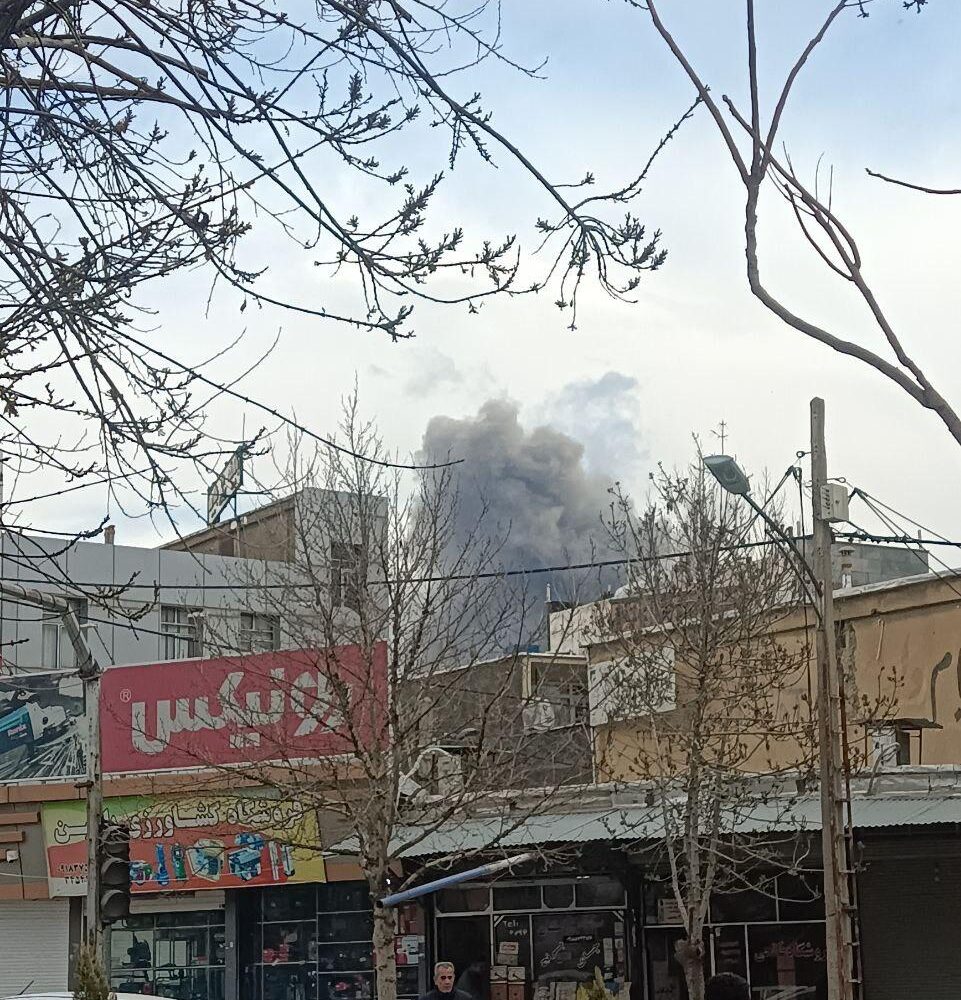
Report from Marivan
During the 12-day war, the “Bardeh-Rasheh” and “Bayaleh” military bases in Marivan were the only places hit. This time, the war reached Marivan by bombing these exact same two places. It was noon on Monday, March 2nd, when the sound of missiles got louder than before. Suddenly, there was a sound like thunder, followed by a huge explosion. The explosion was close. Everyone had come out of their houses. News spread that “Sepah Square” had been hit. The people in the neighbourhood were cheering.
Sepah Square was a large military centre right in the middle of Marivan. A few hours later, news reached the whole city that several houses near the military bases were destroyed and some civilians were killed. The news was still unclear, but you could see that the early cheering was gone. By late night, the news was confirmed. A family of four was killed inside their own home. Mitra Jalilavi, a pregnant woman from Ahvaz, her husband Farzad Bazargan from the village of “Dari” near Marivan, and their 4-year-old child Karen, were all buried under the rubble and died. The war immediately showed its ugly face to the people of Marivan.
After the explosion, the city completely shut down and became empty. Some people moved out of the city to nearby villages or garden houses, and others locked themselves inside their homes. But nighttime gatherings and visits still continued. Political discussions were hot.
After the January [2026] protests, in the city where I live and work, political talks had become a daily habit. Iran’s future was completely unclear. I had seen angry people change their political views with every new event, tweet, or rumour. They were like a steam engine about to explode, with its gauges spinning wildly. The situation in Marivan was similar. Especially after Khamenei was killed and missiles hit Marivan, some people changed their minds. Before, they supported the war, but now they argued that since Khamenei is dead, the war should end too. The problem, however, was that those dropping bombs and missiles on our heads in different cities didn’t think this way. So, the war continued.
***
On Monday, March 9th, at 6:30 AM, three explosions woke up everyone in the city. The sound was so close that houses and windows shook. The news said that the prison, the police station in the middle of the city, and the military barracks were hit. Almost nothing was left of the prison, which had been completely evacuated. After the first day of bombing in Marivan, they had freed most of the prisoners and maybe moved some to other prisons. No casualties were reported, but after this explosion, more people moved to nearby villages, and the city became even emptier.
On March 11th, at 1:00 PM, several heavy explosions shook the city one after another. My window was open, and thick, massive smoke appeared in the sky. They had hit somewhere inside the city. A few days had passed since the last explosion, and the city and streets had gone back to normal. An explosion in the city, especially at this time of day, was terrifying. The news said that several places were hit by missiles, including the border guard station in the middle of the city and the base at the “Biye-Kari” intersection. As usual, people started calling their friends and family to make sure they were safe. During this, news was also shared. According to local witnesses, the number of injured people at the “Biye-Kari” intersection was high. Even a young man named Zana Khorshidi, who was just walking by, was badly injured and died a few days later.
It is strange to me that the names of the people killed in Marivan are not in any media. Some media outlets wrote the names of the family killed on the first day, but the names of the others killed in the following days are nowhere to be found. Setting aside the government media and the pro-war opposition, even many media outlets close to Kurdish political parties which usually have local contacts and can get this news do not mention the civilians killed in Marivan. They also publish very little news about civilians killed in other cities of Kurdistan. It seems that writing about the death of civilians is something everyone wants to avoid. They don’t want people to realize that alongside these “destructions” and “successful hits,” real people are having their homes destroyed and are losing their lives.
The next day, I went to the “Biye-Kari” intersection to see the destruction myself. First, I should say that this intersection connects to Oramanat on one side, to the villages of Chor, Naneh, and Almaneh on another, and to Marivan on the other side. For a long time, there have been supermarkets, oil change shops, and restaurants there. Later, houses were built around it. And on one side, a large military base is located there. All the nearby shops and houses were destroyed. The windows of houses further away were broken. The blast wave was so strong that it broke the windows of some houses even in the village of Chor. The ground inside the military base had turned into a giant crater. Definitely, such destruction at that time of day caused more deaths, but we didn’t know about them, and we remain in the dark.
***
This year, Marivan did not feel like Norouz (the Persian New Year). For a few years now, the Norouz celebration has become a way to show local identity and strength. But this year, under missiles and bombs, in a city that many people had left, there was no sign of Norouz. The streets were empty, and people looked up at the sky at every sound, ready to run for shelter if they sensed danger.
Since everything is paused and completely shut down, I reached out to my Afghan coworkers with difficulty and a sense of shame. The boss told us Iranian workers that we don’t have to work until after the New Year holidays. But my Afghan coworkers, who have nowhere to go, have been at work all these days. And they are working in a city that has been bombed and hit by missiles much more than Marivan. I think about their fears and the bread they must earn just to stay alive. I think about them walking in the streets in a situation where even the old, unfair laws are paused. I think about what will be left of us after this war. I think about Marivan, hit by missiles. I think about the baby who was buried under the rubble before even being born, and I think about the young man who was just walking by and left us forever.
Comment here